The five volcanoes that remember a vanished federation
El Salvador’s coat of arms preserves a political union that disappeared in the nineteenth century—but still survives as five volcanoes on its flag.
Die Geschichte hinter den fünf
Look closely at the centre of El Salvador’s flag and you will find five green volcanoes between two blue seas. They recall Costa Rica, El Salvador, Guatemala, Honduras and Nicaragua: the five states of the Federal Republic of Central America. The provinces declared independence from Spain in 1821, passed through a short annexation to the Mexican Empire, and formed a federation under a constitution issued in 1824. The union fractured through civil conflict and competing local interests, but its blue-white-blue visual language endured across the region. El Salvador restored those colours and adopted its present coat of arms in 1912. The five volcanoes turn the flag into a compact historical map: five countries, one failed union, and an ideal of Central American unity that outlived the state itself. The emblem also places a rainbow, a Phrygian cap and the date 15 September 1821 above the volcanoes. Together, those details compress independence, republican liberty and a still-unfinished regional ambition into one of the densest coats of arms on any national flag.
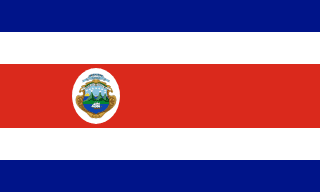 Costa Rica — San José
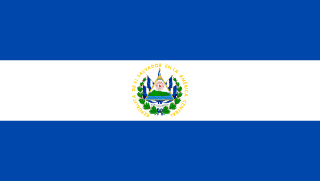 El Salvador — San Salvador
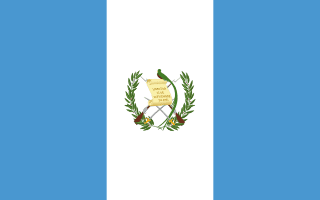 Guatemala — Guatemala-Stadt
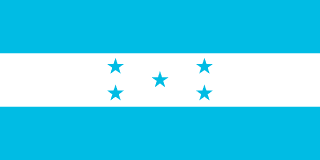 Honduras — Tegucigalpa
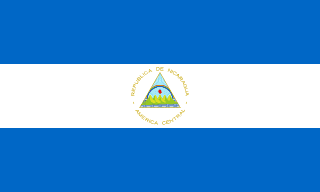 Nicaragua — Managua